Yes to Voter ID!
We are hearing it with greater intensity: we the people. It is no coincidence that the Preamble to the Constitution begins with these three words. I sometimes wonder if we realize all that is enveloped within them. We the people accept the responsibility necessary to make this new government work; we recognize that it has no voice but our voice; that the privileges and responsibilities of self-government, and the measure of its virtue, accrue to us alone, as individuals, speaking in consensus.Voter ID
It is in the realm of elections that we make our voices heard. Our collective values are expressed in the voting booth. To the extent that elections at all levels are fair representations of the voices of the people, we have the government we desire and deserve. The privilege of participation in an election is a pledge we make to each other, much as the founders pledged in the Declaration of Independence their “lives…fortunes and… sacred Honor (US 1776).” Each citizen, informed about the issues involved, has a duty to cast a legal vote.Voter ID
National integrity can be no stronger than that of its individuals. When a nation disregards election integrity, it essentially violates the sacred trust. In our day, any voter identification effort to safeguard the process of “one person, one vote” is met with suspicion.
Electoral laxity is the province of the left, sending the same message spoken by one of my professors in a public university classroom many years ago that “the end justifies the means.” One can only surmise that to them, the electoral process is just a means to an end: electoral advantage. Finding success, they are further emboldened in their disdain for the Electoral College, which ensures that votes matter in every region of the country.
The example from 2020

Donald Trump
The 2020 presidential election may be the most famously debated one in recent memory. Stories abound about stuffed ballot boxes and poll watchers shut out of polling places. Many continue to believe that election was fraudulent, which has led to reduced confidence in the integrity of U.S. elections, an outcome both tragic and telling. The people must believe the sacred trust is still intact. Admittedly, the news story was (and still is) consistently stated that Donald Trump was trying to overturn the outcome of the election. He is entitled to his opinion. But whether or not he intended such, or even said it, the solemn duty of the Vice President, as President of the Senate, is to ascertain the validity of the state elections, and that is the critical issue. Any lingering question should be settled, whether or not the outcome is changed. Several questions had been raised that year; those doubts should have been resolved before the electoral ballots could be counted and the election certified.
Electoral integrity is enhanced by transparency. Perhaps it is ironic that the confidentiality of the vote is upheld by the openness afforded observers of the process itself. A convenient accusation is that poll watchers hinder the privacy of individual voters, but that is neither fair nor accurate, and it obscures the ease with which fraud may occur. Throughout both the voting, and particularly the vote counting, impartial observers are necessary to ensure laws are upheld and fraud is discouraged. As an experienced officer in a voting precinct, I have overseen the voting process from ballot application to ballot cast, and the care required in the preservation and submission of that legal document. That these responsibilities have become controversial is an indication of their significance, of the decline in virtue that is the bedrock of our Constitution, and of the resulting tear in our social fabric.
Distinguishing between photo ID and Real ID
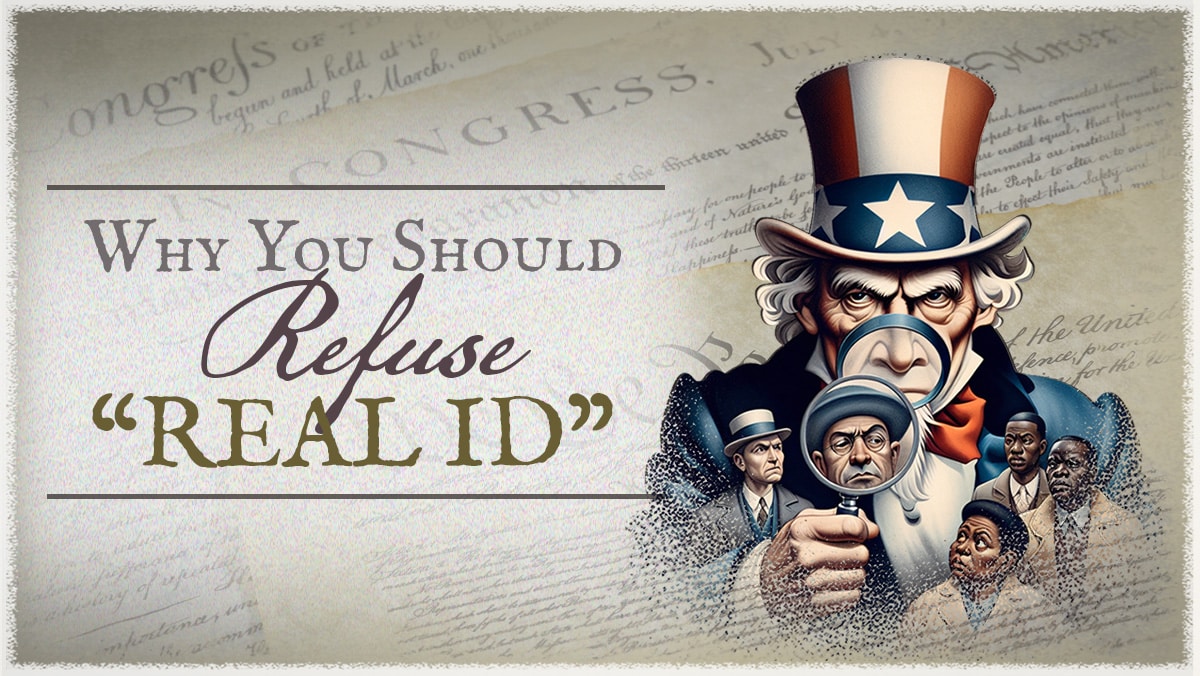
It is important to understand the difference between photo ID and Real ID. The former exists to protect the integrity to ensure that only American citizens can vote in federal elections, and in accordance with the law. Real ID has a very different purpose: control. This is borne out by the fact that those in the country illegally can get a Real ID. It proves nothing about the individual’s ability to cast a vote. It is purely a route to a national database where bureaucrats know everything about us and can exert control over our lives. Consequently, we embrace photo ID to protect electoral integrity but reject Real ID.
Two relevant bills
The SAVE Act (H.R. 22), introduced 1/3/25, purports to address these problems by…
Prohibiting states from accepting and processing an application to register to vote, and to register to vote, in a federal election unless the applicant presents documentary proof of U.S. citizenship.
Requiring states to act on an ongoing basis to ensure that only U.S. citizens are registered to vote.
Requiring states to remove noncitizens from their official lists of eligible voters.
The SAVE Act has passed the U.S. House and is currently in the U.S. Senate. The SAVE America Act (H.R. 7296), introduced 1/30/26, adds a requirement to provide photo identification in order to vote in federal elections. The Heritage Foundation applauded the passage of H.R. 7296 (https://www.heritage.org/press/heritage-applauds-house-passage-legislation-protect-elections) on 2/11/26. This bill remains in the U.S. House.
These bills should not be contentious and we urge our representatives to support them. For more information, see https://www.congress.gov/bill/119th-congress/house-bill/22 and https://www.congress.gov/bill/119th-congress/house-bill/7296.
One undesirable effect of perceived electoral malfeasance is voter cynicism, due to loss of confidence. Low turnout, already a problem and cause for concern, reflects a number of underlying causes, but apathy breaks the sacred trust. It is therefore incumbent upon we the people, to assume our personal responsibility and to hold our electoral officers accountable to their oaths. We owe that much to ourselves and to each other.[1]
Celebrating Our Christian Heritage!
We are a user supported non-profit organization. Your small gift is tax-deductible and will go a long way to help us meet our operating budget — and it is vital, because
America deserves to know its true heritage.
Please contribute today!
Click to donate
America deserves to know its true heritage.
Please contribute today!
[1] Video courtesy of The Federalist Society: Does the Voter ID Requirement Safeguard the Election Process?
Voter ID
Voter ID
Voter ID
Voter ID1
Voter ID2
 Christian Heritage Fellowship Facebook
Christian Heritage Fellowship Facebook
InternalLink
InternalLink
InternalLink
Christian Heritage Fellowship Facebook
Christian Heritage Fellowship Facebook
Christian Heritage Fellowship Facebook
InternalLink
InternalLink
InternalLink
Dr. Kathy L. Flick