God Is—The Evidence of Fine Tuning
This post is part 2 of the series: God Is—Scientific Evidence for God
⎘ Next: God Is—The Evidence of Life
⎗ Previous: God Is—The Evidence of the Cosmos
December 24, 1968
Bill Anders on Apollo Eight captures Earthrise from the lunar horizon while orbiting the Moon
Well over a century ago, scientists began to discover that the Earth, the universe beyond, and the factors that permitted life to exist were not a matter of mere chance. At the beginning of the twentieth century, scientists began to discover finely tuned aspects or factors that allowed humans and all life to exist on Earth, and without these factors, plant or animal life could not survive.Evidence of Fine Tuning
Article Contents
* Click headings to navigate; click headings to return.
Coming soon...
Please click for more information: God Is—Scientific Evidence for the Divine

Goldilocks and the Three Bears
For generations, the story of Goldilocks and the Three Bears has been rehearsed as a rite of passage through childhood. This English fairy tale has at least three versions, but the tale most frequently told concerns a curious little girl named Goldilocks who stumbles upon the wooded cottage of three bears—Papa Bear, Mama Bear, and Baby Bear. While the three bears are away on a family stroll allowing their porridge to cool, Goldilocks enters their cottage and helps herself to their porridge, chairs, and beds.Evidence of Fine Tuning
Trying the porridge first, she found Papa Bear’s too hot, Mama Bear’s too cold, but Baby Bear’s porridge just right and ate every bit of it. Now tired, Goldilocks decided to rest in a chair. Finding Papa Bear’s chair to hard and Mama Bear’s too soft, she settled into Baby Bear’s chair which was just right; here she remained until the bottom broke sending her to the floor. Determined to find rest, Goldilocks ambled upstairs and found Papa Bear’s bed too high at the head, Mama Bear’s bed too high at the foot, but Baby Bear’s bed just right, and here she fell fast asleep.
Upon returning home, the three bears found their uninvited guest had tried their porridge, sat in their chairs, and was now sleeping in Baby Bear’s bed. Awakened and alarmed by the presence of her hosts, Goldilocks dashed to an open window and made her escape into the woods.[1]
This fairy tale has been used to succinctly describe the unique conditions that permit and sustain life on Earth. “The Goldilocks universe” is an expression that has come to describe the growing number of discovered fortunate factors that are necessary for the existence of complex forms of life—not too hot, not too cold, but just right. Other terms are used to describe the same idea. “Fine-tuned parameters” and “anthropic coincidences”[2] are expressions also employed by scientists to describe the existence of narrowly defined natural limits that permitted life to exist on Earth.
Well over a hundred years ago, scientists began to discover very narrowly defined limits in the world around us that permitted life to exist on earth. Throughout the twentieth century, real science plunged into greater depths of scientific truth concerning the world around us only to discover that we live in a far more complex world than Charles Darwin anticipated in 1859[3]—and discoveries of fine tuning verified the extreme uniqueness of the earth and universe in which we live.
One of the first books to be published concerning the fine tuning of nature was first printed in 1913. It was written by Harvard professor of chemistry, Lawrence Henderson titled, The Fitness of the Environment: An Inquiry into the Biological Significance of the Properties of Matter.[4] Among the fine-tuning properties addressed in his book was the subject of water and the importance of environment to living things. The prevalence and properties of water are often overlooked, but Henderson understood its essential role in life on Earth—something that has also been recognized by Dr. Michael Denton in his book, The Wonder of Water.[5]

Fred Hoyle
But more than forty years would pass following the publication of Professor Henderson’s book before one newly discovered fine-tuning parameter and its application would change the worldview of a very distinguished atheist. Sir Fred Hoyle (June 24, 1915 – August 20, 2001) was an English astronomer who is credited with jokingly coining the expression “Big Bang”—an utterance intended to ridicule the idea that the universe had a beginning. Though astrological evidence pointed away from Hoyle’s “steady-state model” of the universe toward a beginning of the universe, he never could bring himself to accept that evidence. Most of his working life was spent at St. John’s College, Cambridge where he served as founding director of the Institute of Theoretical Astronomy. For his distinguished career as a scientist, he was knighted in 1972 in the New Year Honors. Born near Bingley in Gilstead, West Riding in Yorkshire, England, Hoyle in his youth sang in the choir at his local Anglican church[6] but became an atheist apparently in his early years as a scientist. In April 1951, a published article appeared in which he openly rejected his Anglican up-bringing in favor of atheism:
Religion is but a desperate attempt to find an escape from the truly dreadful situation in which we find ourselves….No wonder then that many people feel the need for some belief that gives them a sense of security, and no wonder that they become very angry with people like me who say that this is illusory.[7]
However, in the years that followed the publication of this article, Hoyle’s own scientific discoveries vigorously shook his denial of God.[8] By 1953,[9] Hoyle had begun to realize that it was highly improbable that the conditions and laws that permitted life on Earth were mere accidents. Hoyle knew that carbon was abundant in the universe and that this element was essential to all forms of animate life. The long chain-like molecules that carbon forms carry information and store energy that are crucial to the survival of living cells.[10] He discovered that the natural formation of carbon to sustain animated life was not a simple task but the result of finely tuned parameters. In his 1983 book, Hoyle expressed his appreciation for the narrow limits of nature that enabled the existence of life when he wrote, “The list of anthropic properties [fine-tuned parameters]… is large and impressive.”[11] That Hoyle’s discovery of the extremely narrow limits of carbon formation in stars convinced him that chance could not account for the fine-tuning parameters that were being discovered is very apparent. Two years earlier (in 1981), he reflected upon the implications of his life’s work and his scientific findings and rejected the atheism to which he had given voice in 1951:
A commonsense interpretation of the facts suggests that a super-intellect has monkeyed with physics, as well as with chemistry and biology, and that there are no blind forces worth speaking about in nature. The numbers one calculates from the facts seem to me so overwhelming as to put this conclusion almost beyond question.[12]

Robert Dicke
Among the prominent voices that were identifying the extremely narrow life-permitting parameters discovered in the twentieth century was Robert H. Dicke, (May 6, 1916 – March 4, 1997), the Albert Einstein Professor of Science at Princeton University (1975–1984). Dicke was an American astronomer and physicist who made important contributions to the fields of atomic physics, cosmology, astrophysics, and gravity. Along with Jim Peebles, Dicke had predicted the early expansion of the universe would have created a cosmic microwave background radiation, which was accidentally discovered by Arno Penzias and Robert Woodrow Wilson at the Bell Labs, in Holmdel, New Jersey in 1964. In 1961, Dicke argued that for life to exist in the universe forces in physics (such as gravity and electromagnetism) must be perfectly fine tuned.[13]
How Many Fine-Tuned Parameters?
The exact number of known fine-tuning factors is a matter of some debate, but some have offered a specific number. A brief consideration of the varying opinions concerning the number of known parameters may help the reader avoid a dogmatic stand on this specific topic.

Stephen Hawking
Atheist Stephen Hawking (January 8, 1942 – March 14, 2018) was an astrophysicist, cosmologist, and director of research at the Center for Theoretical Cosmology at the University of Cambridge. From 1979 to 2009, he held the Lucasian Professor of Mathematics at Cambridge, a position widely regarded as one of the most distinguished academic posts in the world. In his writings, Dr. Hawking acknowledged the existence of fine-tuning parameters that permitted life on earth and yet apparently regarded them as the product of mere chance.[14] In 1997, an article appeared in the Austin American-Statesman in which Hawking identified a specific number of parameters—but resisted any effort to settle upon a definitive or conclusive number: “The universe and the laws of physics seem to have been specifically designed for us. If any of about 40 physical qualities had more than slightly different values, life as we know it could not exist.”[15]

Guillermo Gonzalez and Jay Richards
In 2024, Christian scientists Dr. Guillermo Gonzalez and Dr. Jay Richards published the twentieth-anniversary edition of their book, The Privileged Planet: How Our Place in the Cosmos is Designed for Discovery. Dr. Gonzalez has taught at the University of Washington, Iowa State University, Grove City College, and Ball State University, and has served as Senior Fellow at Discovery Institute’s Center for Science and Culture.[16] Dr. Richards is an award-winning author, writing and editing more than a dozen books, and serves as the William E. Simon senior research fellow in The Heritage Foundation’s DeVos Center for Religion and Civil Society and is a Senior Fellow at the Discovery Institute.[17] As co-authors of The Privileged Planet, Gonzalez and Richards have illuminated some of the most critical fine-tuning parameters that make life possible on Earth. Their book is one of the most valuable works on fine tuning from a Christian perspective.
In a separate article, Dr. Richards has classified more than twenty parameters but makes no attempt to claim a specific number. Making no attempt to list all known fine-tuning parameters, he anticipates and acknowledges the question concerning additional factors:
In discussing fine-tuned parameters, one can take either a maximal or a minimal approach. Those who take the maximal approach seek to create as long a list as possible. For instance, one popular Christian apologist listed thirty-four different parameters in one of his early books, and maintains a growing list, which currently has ninety parameters. He also attaches exact probabilities to various “local” factors.[18]
The Size of the Earth—One Example

Earthrise
The fourteenth fine-tuned parameter in Dr. Richards’ list of twenty-two is “right planetary mass” with respect to the Earth. The size of the Earth is one of the most important of the life-permitting parameters. Following World War II, America was engaged in the Cold War geopolitical rivalry with the Soviet Union. After consulting with advisors, President John F. Kennedy chose a project that was calculated to out distance Soviet space initiatives by landing a man on the Moon and returning him to the Earth. This space initiative was dubbed Project Apollo. On December 21-27, 1968, the Apollo 8 mission was the first manned spacecraft to leave Earth’s gravitational sphere and the first human spaceflight to reach and orbit the Moon. Though the Apollo 8 capsule did not land on the Moon, crew members Frank Borman, Jim Lovell, and William Anders orbited the Moon ten times. These men were the first humans to see and photograph the far side of the Moon and an Earthrise. On December 24, 1968, Bill Anders photographed the Earth rising for the third time on the lunar horizon while orbiting the Moon—an image which is now iconic and which serves as a poignant reminder of the uniqueness of the Earth from all other known bodies of the universe.

Magnetosphere of the Earth
Why does the size of the Earth matter? The simple answer concerns the magnetic field surrounding it. An understanding of “solar wind” is important to appreciating the optimal size of the Earth. The Sun’s outermost layer releases a stream of charged particles or plasma consisting of “ionized hydrogen (electrons and protons) with an 8% component of helium (alpha particles) and trace amounts of heavy ions and atomic nuclei…”[19] As the solar winds hurdle toward the Earth, their devastating gale is blunted by the “magnetosphere”—that electrical magnetic force surrounding the earth. The magnetosphere protects the earth from the harmful effects of the solar winds like an umbrella protects its user from the rain. If the Earth were smaller, its magnetosphere would be too weak to protect it and would strip the atmosphere of life-giving hydrogen and oxygen—leaving the earth like barren Mars. And if Earth was larger, a more powerful gravity would compress the atmosphere, so that harmful gases would increase making surface air, according to Gonzalez and Richards, “more viscous.” Thus, “Earth may be about as big as a terrestrial planet can get without ending up with a deep ocean and a thick atmosphere.”[20]
Few of us ever consider the fine-tuned parameters that placed the Earth in an ideal orbit around the Sun, afforded planetary protection from asteroids with Jupiter and Saturn, and provided our Earth with one unique Moon. Who would have guessed that our Earth is the only known planet to contain the right amount of water in the crust to sustain carbon-based life? Did these parameters and so many, many more occur only by chance as suggested by atheists? Answering this question, Donald Page of Princeton’s Institute for Advanced Science calculates that the odds of the universe randomly producing the conditions necessary to sustain life to be one in ten billion to the 124th power.[21]
Conclusion: Fine-Tuning Challenge to Atheism

Dawkins, Hitchens, Harris, Dennett
It is this fine-tuning or Goldilocks universe argument that has been one of the strongest bullworks against the contemporary revival of atheism. The expression, “New Atheism,” was coined by writer Gary Wolf in an article he published in 2006. Major figures in the New Atheism movement include Richard Dawkins, Sam Harris, Christopher Hitchens, and Daniel Dennett. These four men have been described as the “Four Horsemen” of New Atheism,[22] but they are by no means the only ones attempting to advance the claims of this godless worldview. To this truncated list may be added well-known figures such as the late Carl Sagan,[23] Peter Singer, Sean Carroll, Lawrence Krauss, and many others.[24] In debates with theists or Christian defenders, these advocates of atheism have often sought to champion their cause by resorting to the embarrassment of their opponents rather than engage in an arduous pursuit of truth.[25]
Christopher Hitchens was not known to concede the least credibility to his God-defending opponents, but on one very rare occasion, he expressed the difficulty that the fine-tuning argument of the universe posed for him and his atheistic advocates. When riding in the back seat of a car, someone in the front seat suddenly turned to Hitchens, put a camera in his face, and asked him what he believed was the best argument for God used by his opponents. With rare candor, he answered quickly, saying,
It is the fine-tuned argument. The fine-tuning, that one degree, well, one degree, one hair [of difference]… even though it doesn’t prove design, doesn’t prove a Designer…. You have to spend time thinking about it, working on it. It’s not a trivial [argument]. We all say that.[26]
By “we all,” Hitchens meant all Four Horsemen of atheism. Despite the fact that the fine-tuning argument of the universe as a defense for the existence of God did not convince Hitchens or his atheistic compatriots, it was a powerful argument of one of the first discoverers of fine tuning.

Anthony Flew
Before concluding this topic, one more anecdote is appropriate. On December 9, 2004, an Associated Press headline announced, “Famous Atheist Now Believes in God, More or Less, Based on Scientific Evidence.”[27] That atheist was Anthony Flew, son of a well-known British Methodist minister, Rev. Robert Newton Flew—author of The Idea of Perfection in Christian Theology.[28] As a boy, Anthony became disenchanted with Christianity. In 1950, he presented his paper, “Theology and Falsification,” at a meeting of the Socratic Club then chaired by distinguished Christian apologist, C. S. Lewis. That paper became the most widely reprinted philosophical publication of the last century. Through his various writings, Anthony Flew became one of the most widely known atheists of the late-twentieth century.
But in 2004, Flew changed his mind, and three years later published his explanation for this metamorphosis of thought in his book, There Is a God: How the World’s Most Notorious Atheist Changed His Mind. And what was the chief reason for his abandoning his life-long love of atheism? It was the scientific evidence for a “finely tuned universe.” “In other words,” he writes, “the laws of nature seem to have been crafted so as to move the universe toward the emergence and sustenance of life.”[29] And then, responding to those—particularly atheists—who say, “The Earth just got lucky; there could be millions of unknown universes among which exist similar planets where fine-tuned life-permitting parameters exist…” To this faith statement of atheists, Anthony Flew responded, “Virtually no major scientist today claims that the fine tuning was purely a result of chance factors at work in a single universe.”[30] Drawing upon the preponderance of scientific opinion, Flew maintained that no “major scientist” believed that all of the known fine tuning parameters that enabled life could occur by accident in any “single universe.” The fact that humans are the beneficiaries of the convergence of so many fine-tuning parameters insists it is not by accident, but by Divine design.
Sadly, Anthony Flew did not have to wait until the end of his life to realize science provides warrant to believe in God. In addition to the natural evidence for the existence of God that has been known to man since creation, science in the twentieth century sifted out a preponderance of evidence in natural examples that demonstrate the world did not happen by accident but was finely tuned in preparation for the existence of life by the eternal God.
Celebrating Our Christian Heritage!
We are a user supported non-profit organization. Your small gift is tax-deductible and will go a long way to help us meet our operating budget — and it is vital, because
America deserves to know its true heritage.
Please contribute today!
Click to donate
America deserves to know its true heritage.
Please contribute today!
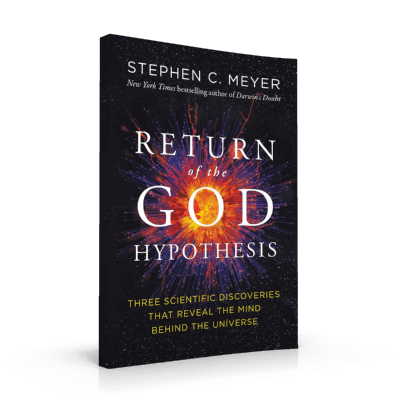
Stephen C. Meyer, Return of the God Hypothesis: Three Scientific Discoveries That Reveal the Mind Behind the Universe. The New York Times bestselling author of Darwin’s Doubt, Stephen Meyer, presents groundbreaking scientific evidence of the existence of God, based on breakthroughs in physics, cosmology, and biology. Beginning in the late 19th century, many intellectuals influenced by scientific materialism began to insist that scientific knowledge conflicts with traditional theistic belief―that science and belief in God are 'at war.' Philosopher of science Stephen Meyer challenges this view by examining three scientific discoveries with decidedly theistic implications. Purchase here...
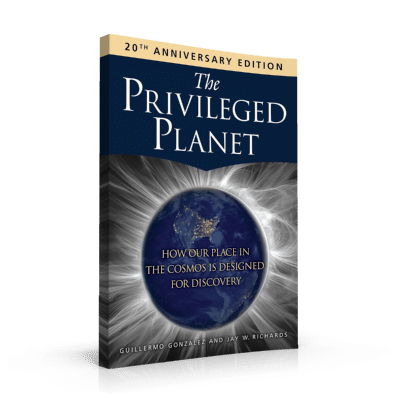
Guillermo Gonzalez and Jay W. Richards, The Privileged Planet: How Our Place in the Cosmos Is Designed for Discovery. The Provocative Classic The Privileged Planet in a Fully Revised, 20th Anniversary Edition! Are we just an accident of cosmic evolution? Is Earth a “lonely speck in the great enveloping cosmic dark” as the late Carl Sagan put it? Or is there more to the story? In this provocative book, Guillermo Gonzalez and Jay W. Richards marshal a staggering array of scientific evidence to counter the modern dogma that Earth is nothing more than the winner of a blind cosmic lottery. Purchase here...

Paul Davies, The Goldilocks Enigma: Why Is the Universe Just Right for Life?. The Goldilocks Enigma is Paul Davies’s eagerly awaited return to cosmology, the successor to his critically acclaimed bestseller The Mind of God. Here he tackles all the 'big questions,' including the biggest of them all: Why does the universe seem so well adapted for life? In his characteristically clear and elegant style, Davies shows how recent scientific discoveries point to a perplexing fact: many different aspects of the cosmos, from the properties of the humble carbon atom to the speed of light, seem tailor-made to produce life. Purchase here...
[srp post_limit=’5′ category_include=18, 6322 srp]
*Materials included below in our "Selected Works" section have been consulted in the research of this article, but the opinions contained in them are not necessarily those held and supported by
Christian Heritage Fellowship, Inc.
Christian Heritage Fellowship, Inc.
Campbell, Charlie H. Evidence for God: Reasons to Believe from Cosmology, Biology, Philosophy, History, and the Bible. Carlsbad, CA: Always Be Ready Apologetics Ministry, 2023.
Darwin, Charles. The Origin of Species By Means of Natural Selection: Or, the Preservation of Favored Races in the Struggle for Life. London: John Murray, 1859.
Dawkins, Richard. The God Delusion. London: Black Swan, 2016.
Denton, Michael. The Wonder of Water: Water’s Profound Fitness for Life on Earth and Mankind. The Privileged Species. Seattle: Discovery Institute Press, 2017.
Dicke, Robert H. “Dirac’s Cosmology and Mach’s Principle.” Nature, 1961.
Flew, Antony and Roy Abraham Varghese. There Is a God: How the World’s Most Notorious Atheist Changed His Mind. New York: HarperOne, 2008.
Flew, R. Newton. The Idea of Perfection in Christian Theology: An Historical Study of the Christian Ideal for the Present Life. Oxford University Press, 1934.
Gonzalez, Guillermo and Jay W. Richards. The Privileged Planet: How Our Place in the Cosmos is Designed for Discovery. 20th Anniversary ed. New York: Regnery Gateway, 2024.
Graps, Amara. “What is the chemical composition of the solar wind?” Stanford Solar Center. Last modified Accessed March 27, 2026. https://solar-center.stanford.edu/FAQ/Qsolwindcomp.html.
Hawking, Stephen. A Brief History of Time: From the Big Bang to Black Holes. New York: Bantam Books, 1988.
Henderson, Lawrence J. The Fitness of the Environment: An Inquiry into the Biological Significance of the Properties of Matter. New York: The Macmillan Company, 1913.
Hoyle, Fred. “The Expanding Universe: The Nature of the Universe, Part V.” Harper’s Magazine, April, 1951.
Hoyle, Fred. “The Universe: Past and Present Reflections.” Engineering & Science [Caltech Magazine], November, 1981.
Hoyle, Fred. The Intelligent Universe. New York: Holt, Rinehart and Winston, 1983.
Institute, Discovery. “Guillermo Gonzalez: Senior Fellow, Center for Science and Culture.” Last modified Accessed March 27, 2026. https://www.discovery.org/p/gonzalez/.
Institute, Discovery. “Jay W. Richards: Senior Fellow at Discovery, Director of DeVos Center at Heritage Foudation.” Last modified Accessed March 27, 2026. https://www.discovery.org/p/gonzalez/.
Metaxas, Eric. Is Atheism Dead? Washington, DC: Salem Books, 2021.
Meyer, Stephen C. Return of the God Hypothesis: Three Scientific Discoveries That Reveal the Mind Behind the Universe. New York: HarperOne, 2021.
Mitton, Simon. Fred Hoyle: A Life in Science. London: Aurum, 2005.
Moore, Frazier. “Hawking Brings ‘Universe’ on PBS Down to Earth.” Austin American-Statesman. October 19, 1997.
Richards, Jay. “List of Fine-Tuning Parameters.” Discovery Institute. Last modified Accessed April 16, 2026. https://intelligentdesign.org/articles/list-of-fine-tuning-parameters/.
Steel, Flora Annie. “The Story of the Three Bears.” In English Fairy Tales, 19–24. New York: The MacMillan Company, 1922.
Thompsen, Dietrick E. “The Quantum Universe: A Zero-Point Fluctuation.” Science News 128, no. 5 (August 3 1985).
Wolf, Gary. “The New Atheism, The Church of the Non-Believers.” Wired Magazine, November, 2006.
[1] Flora Annie Steel, “The Story of the Three Bears,” in English Fairy Tales (New York: The MacMillan Company, 1922).
[2] Physicists refer to these fortunate factors or values as “anthropic coincidences” and to the convergence of these factors which permit life as the “anthropic fine tuning” of the universe. Stephen C. Meyer, Return of the God Hypothesis: Three Scientific Discoveries That Reveal the Mind Behind the Universe (New York: HarperOne, 2021), 31.
[3] Darwin first published his Origin of Species in 1859 that suggested the cell was not complex, but only a blob of tissue. Charles Darwin, The Origin of Species By Means of Natural Selection: Or, the Preservation of Favored Races in the Struggle for Life (London: John Murray, 1859).
[4] Lawrence J. Henderson, The Fitness of the Environment: An Inquiry into the Biological Significance of the Properties of Matter (New York: The Macmillan Company, 1913).
[5] Michael Denton, The Wonder of Water: Water’s Profound Fitness for Life on Earth and Mankind, The Privileged Species (Seattle: Discovery Institute Press, 2017).
[6] Simon Mitton, Fred Hoyle: A Life in Science (London: Aurum, 2005), 26.
[7] Fred Hoyle, “The Expanding Universe: The Nature of the Universe, Part V,” Harper’s Magazine, April, 1951.
[8] Meyer, Return of the God Hypothesis, 131.
[9] Fred Hoyle, “The Universe: Past and Present Reflections,” Engineering & Science [Caltech Magazine], November, 1981.
[10] Though speculation has swirled around the possibility of life being based upon some element than carbon, physicists have largely rejected such conjectures. See article by distinguished the late astronomer and physicist, Robert Henry Dicke (May 6, 1916-March 4, 1997)—the Albert Einstein Professor in Science at Princeton University (1975–1984): Robert H. Dicke, “Dirac’s Cosmology and Mach’s Principle,” Nature, 1961, 440–441.
[11] Fred Hoyle, The Intelligent Universe (New York: Holt, Rinehart and Winston, 1983), 219.
[12] Hoyle, “The Universe: Past and Present Reflections,” 12.
[13] Dicke, “Dirac’s Cosmology and Mach’s Principle.”
[14] Hawking writes, “The laws of science, as we know them at present, contain many fundamental numbers, like the size of the electric charge of the electron and the ratio of the masses of the proton and the electron. … The remarkable fact is that the values of these numbers seem to have been very finely adjusted to make possible the development of life.” Stephen Hawking, A Brief History of Time: From the Big Bang to Black Holes (New York: Bantam Books, 1988), 7, 125.
[15] Frazier Moore, “Hawking Brings ‘Universe’ on PBS Down to Earth,” Austin American-Statesman, October 19, 1997. Cited in Charlie H. Campbell, Evidence for God: Reasons to Believe from Cosmology, Biology, Philosophy, History, and the Bible (Carlsbad, CA: Always Be Ready Apologetics Ministry, 2023).
[16] Discovery Institute, “Guillermo Gonzalez: Senior Fellow, Center for Science and Culture,” March 27, 2026; https://www.discovery.org/p/gonzalez/.
[17] Discovery Institute, “Jay W. Richards: Senior Fellow at Discovery, Director of DeVos Center at Heritage Foudation,” March 27, 2026; https://www.discovery.org/p/gonzalez/.
[18] Jay Richards, “List of Fine-Tuning Parameters,” Discovery Institute, April 16, 2026; https://intelligentdesign.org/articles/list-of-fine-tuning-parameters/.
[19] Amara Graps, “What is the chemical composition of the solar wind?,” Stanford Solar Center, March 27, 2026; https://solar-center.stanford.edu/FAQ/Qsolwindcomp.html.
[20] Guillermo Gonzalez and Jay W. Richards, The Privileged Planet: How Our Place in the Cosmos is Designed for Discovery, 20th Anniversary ed. (New York: Regnery Gateway, 2024), 53.
[21] Dietrick E. Thompsen, “The Quantum Universe: A Zero-Point Fluctuation,” Science News 128, no. 5 (August 3 1985): 73. Cited by Campbell, Evidence for God, 19.
[22] Gary Wolf, “The New Atheism, The Church of the Non-Believers,” Wired Magazine, November, 2006.
[23] Dawkins charges Sagan with “agnosticism” with regard to the question of whether there is life elsewhere in the universe. Richard Dawkins, The God Delusion (London: Black Swan, 2016), 69.
[24] See Varghese additions in, Antony Flew and Roy Abraham Varghese, There is a God: how the world’s most notorious atheist changed his mind (New York: HarperOne, 2008), xvi.
[25] See Roy Varghese’s ridicule of Dawkins and his fellow atheists in, Flew and Varghese, There is a God, viiff, 159ff.
[26] Eric Metaxas, Is Atheism Dead? (Washington, DC: Salem Books, 2021), 35.
[27] Flew and Varghese, There is a God, vii.
[28] R. Newton Flew, The Idea of Perfection in Christian Theology: An Historical Study of the Christian Ideal for the Present Life (Oxford University Press, 1934).
[29] Flew and Varghese, There is a God, 114.
[30] Flew and Varghese, There is a God, 115.
[31] Romans 1:19-20.
Evidence of Fine Tuning
Evidence of Fine Tuning
Evidence of Fine Tuning
Evidence of Fine Tuning
Evidence of Fine Tuning
Evidence of Fine Tuning
Evidence of Fine Tuning
Evidence of Fine Tuning
Evidence of Fine Tuning
Evidence of Fine Tuning
Evidence of Fine Tuning
Evidence of Fine Tuning
Evidence of Fine Tuning
Evidence of Fine Tuning
Evidence of Fine Tuning
Evidence of Fine Tuning
Evidence of Fine Tuning1
Evidence of Fine Tuning2
Evidence of Fine Tuning3
Evidence of Fine Tuning4
Evidence of Fine Tuning5
Evidence of Fine Tuning6
Evidence of Fine Tuning7
Evidence of Fine Tuning8
Evidence of Fine Tuning9
Evidence of Fine Tuning10
Evidence of Fine Tuning11
Evidence of Fine Tuning12
Evidence of Fine Tuning13
Evidence of Fine Tuning14
Evidence of Fine Tuning15
 Christian Heritage Fellowship Facebook
Christian Heritage Fellowship Facebook
Christian Heritage Fellowship Facebook
Christian Heritage Fellowship Facebook
Christian Heritage Fellowship Facebook
Christian Heritage Fellowship Facebook
Christian Heritage Fellowship Facebook
Christian Heritage Fellowship Facebook
Christian Heritage Fellowship Facebook
Christian Heritage Fellowship Facebook
Christian Heritage Fellowship Facebook
Christian Heritage Fellowship Facebook
Christian Heritage Fellowship Facebook
Christian Heritage Fellowship Facebook
Christian Heritage Fellowship Facebook
Christian Heritage Fellowship Facebook
Christian Heritage Fellowship Facebook
Christian Heritage Fellowship Facebook
Christian Heritage Fellowship Facebook
Christian Heritage Fellowship Facebook
Christian Heritage Fellowship Facebook
Christian Heritage Fellowship Facebook
InternalLink
InternalLink
InternalLink
InternalLink
InternalLink
InternalLink
InternalLink
InternalLink
InternalLink
InternalLink
InternalLink
InternalLink
InternalLink
InternalLink
InternalLink
InternalLink
InternalLink
InternalLink
InternalLink
InternalLink
InternalLink
InternalLink
InternalLink
Dr. Stephen Flick
Christian Heritage Fellowship Facebook
Christian Heritage Fellowship Facebook
Christian Heritage Fellowship Facebook
Christian Heritage Fellowship Facebook
Christian Heritage Fellowship Facebook
Christian Heritage Fellowship Facebook
Christian Heritage Fellowship Facebook
Christian Heritage Fellowship Facebook
Christian Heritage Fellowship Facebook
Christian Heritage Fellowship Facebook
Christian Heritage Fellowship Facebook
Christian Heritage Fellowship Facebook
Christian Heritage Fellowship Facebook
Christian Heritage Fellowship Facebook
Christian Heritage Fellowship Facebook
Christian Heritage Fellowship Facebook
Christian Heritage Fellowship Facebook
Christian Heritage Fellowship Facebook
Christian Heritage Fellowship Facebook
Christian Heritage Fellowship Facebook
Christian Heritage Fellowship Facebook
Christian Heritage Fellowship Facebook
Christian Heritage Fellowship Facebook
InternalLink
InternalLink
InternalLink
InternalLink
InternalLink
InternalLink
InternalLink
InternalLink
InternalLink
InternalLink
InternalLink
InternalLink
InternalLink
InternalLink
InternalLink
InternalLink
InternalLink
InternalLink
InternalLink
InternalLink
InternalLink
InternalLink
InternalLink
Dr. Stephen Flick