When Congress Voted to Purchase and Print the Bible
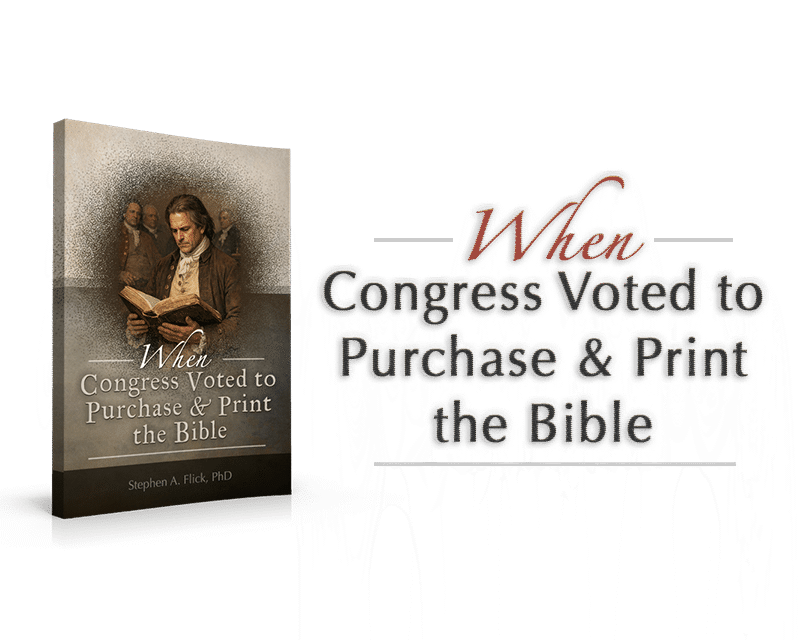
Coming soon…
That America’s Founding Fathers sought to establish their nation upon the principles of the Bible is evident from the testimony of thousands historical proofs. The thirteen British American colonies had been established upon charters that provided ample evidence a Christian moral and spiritual foundations. And the state charters that were composed upon the signing of the Declaration of Independence offered the same testimony.
Most of the American colonies had established state churches, and all possessed a Christian ethos in their respective governments. Because the American colonies and subsequent states were diverse in their Christian theological and denominational, it would have been impossible to find agreement to ratify the Constitution had the Founders attempted to establish a national state church. Why did the Founders refuse to establish a national state church? Because most states already had established state churches or very strong theological convictions that would have prohibited a unified national state church.
But just because the Founding Fathers would never agree to uniformity of Christian worship did not mean that they could not agree on some means of advancing their Christian Faith. During the War of Independence, Congress issued sixteen proclamations calling the states to fasting, prayer, and thanksgiving. Also, Congress attempted to facilitate the distribution of the Bible by voting to purchase and print the Bible. Our book, When Congress Voted to Purchase and Print the Bible, briefly details the issues related to the efforts of Congress to facilitate access to the Bible as chronicled in the minutes of Congress. This is but one of thousands of proofs of America’s Christian foundation.
 In His Steps—What Would Jesus Do? Posted in: Christian Social Influence, Devotional, Historical, Products - The nineteenth century witnessed enormous social concern on the part of Christians throughout America. Volunteer movements of every type arose to apply the ointment of the Gospel to the wounds of the human condition. Alcohol and opiate use were rampant, and from this social ill arose the prohibition movement.… …
 The Influence of Christianity upon the Declaration of Independence Posted in: American Founding Fathers, Products - At the beginning of the twenty-first century, America struggles to identify the principles that distinguished her rise to world prominence. Since the end of the nineteenth century, Marxism and Darwinism have been the implements of choice employed by those seeking Her overthrow. Both of these worldviews have been evoked… …
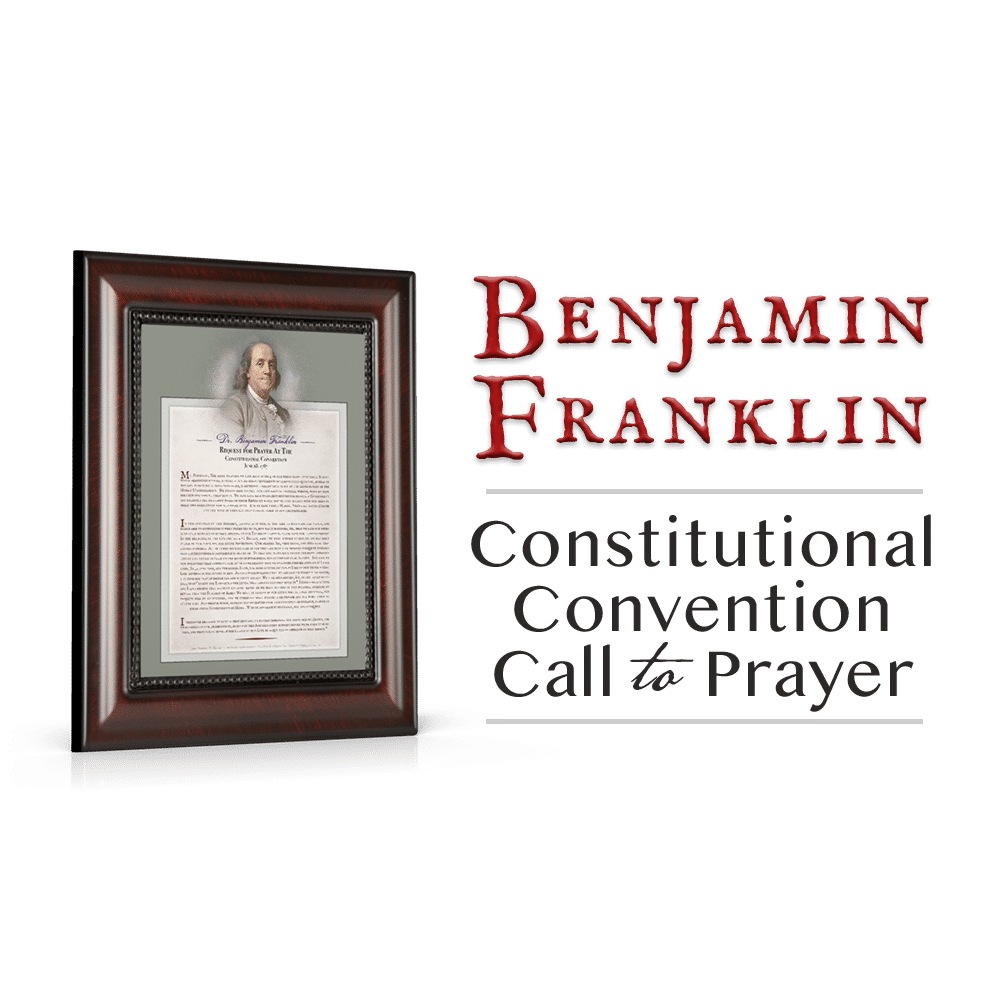 Hallmark: Benjamin Franklin Calls for Prayer Posted in: Decor, Heritage Hallmarks, June Now, Prayer, Products - On June 28, 1787, Dr. Benjamin Franklin rose on the floor of the Constitutional Convention and addressed himself to "Mr. President"—the chairman of the Convention, George Washington. For nearly a month, delegates from the thirteen American states had made little progress in developing a form of national government. Mr.… …
 When Congress Asked America to Fast, Pray, and Give Thanks Posted in: American History, Christian Calendar (Holidays), Christian History, Historical, June, Products - On June 12, 1775, the Continental Congress issued one of its first fast day proclamations when John Hancock of Massachusetts was president of Congress. Hancock, one of the wealthiest Americans of his day, was the son and grandson of Christian ministers and was personally a deeply committed Christian. But… …