Remembering the Apostle Bartholomew
This post is part 8 of the series:
August 24
Remembered by the Western Church
Bartholomew, one of the twelve apostles of Christ (Matthew 10:3; Mark 3:18; Luke 6:14; Acts 1:13) is generally believed to have been the same individual who is called Nathanael in John’s Gospel. The justification for this opinion is that in the first three gospels Philip and Bartholomew are constantly named together, but Nathanael is nowhere mentioned. In the fourth gospel Philip and Nathanael are mentioned in combination, but nothing is said of Bartholomew. Of the gospel writers, John uses Nathanael to describe this apostle while the other three gospels (and the Acts of the Apostles) refer to him as Bartholomew. Herbert Lockyer has harmonized this apparent discrepancy:
Actually the full name of the apostle we are now considering is Nathanael Bartholomew for the consensus among the best and most reliable commentators is that the Nathanael John mentions (1:45-51; 21:2) is the Bartholomew spoken of in the lists of the apostles in the Acts and the other three gospels (Matt. 10:3; Mark 3:18; Luke 6:14, and Acts 1:13). Perhaps we can try to gather the evidence for the identification of Nathanael with Bartholomew. It was common enough for a man to have more names than one -a fact the apostolic circle illustrates. Simon was surnamed Peter and Bar-jona; Matthew was called Levi; Lebbaeus, Thaddaeus, and Judas are names of one and the same person as we shall presently discover. It is a general practice today for people to have several names. For instance, my full signature is Herbert Henry John Lockyer. Bar-Tolmai then, corresponding to Bartholomew, was Nathanael’s surname. . . .
Evidence that Bartholomew and Nathanael are one and the same person may be adduced in this way. Nathanael is twice named by John, and on the first occasion John places him among the first disciples to respond to the call of Jesus. The somewhat lengthy account of his call would be altogether disproportionate unless he were afterward elevated to the apostolate. Then John mentions Nathanael as being among the seven disciples who went back to their fishing (21:2) and it is to be assumed that the word disciples here is equivalent to the word apostles, especially as Nathanael is chosen to be a personal witness of the Lord’s resurrection-a great and glorious privilege![1]
His Introduction to Jesus (ca. 27)
As implied by the Gospel of John, it is likely Bartholomew was a native of Canna in Galilee (John 21:2). He was introduced to Jesus by Philip; upon seeing Bartholomew approach him, Jesus pronounced a declaration concerning his character which has made his name almost synonymous with sincerity or integrity: “Behold an Israelite indeed, in whom there is no guile” (John 1:47).
Post-Resurrection Participant (ca. 30)
Bartholomew was one of the disciples to whom Christ appeared at the Sea of Tiberias following his resurrection (John 21:2). He was also a witness of the ascension and was among those who returned to Jerusalem with the other disciples (Acts 1:4, 12, 13).
As is true of many of the other apostles, little is known of the subsequent life and ministry of Bartholomew beyond vague traditions. The famed church historian Eusebius, suggested that when, toward the end of the second century, Christian missionary Pantaenus embarked on a mission to India, he found they already possessed the Gospel of Matthew written in Hebrew which had been left there by the Apostle Bartholomew. In support of this position Jerome offers a similar account and adds that Pantaenus brought the copy of Matthew’s Gospel back to Alexandria with him.
However, the title of “Indians” was applied by ancient writers to many different nations, and for this reason, it is difficult to determine the precise scene of Bartholomew’s labors as reflected by various Church historians. Mosheim and Neander believed Bartholomew labored in a portion of Arabia Felix, which was inhabited by Jews for whom a Hebrew gospel would be of particular benefit. Historian Socrates believed that it was the India bordering on Ethiopia; and still further, Sophronius suggests that Bartholomew preached the Gospel of Christ to the inhabitants of India Felix.
Martyrdom and Memorial
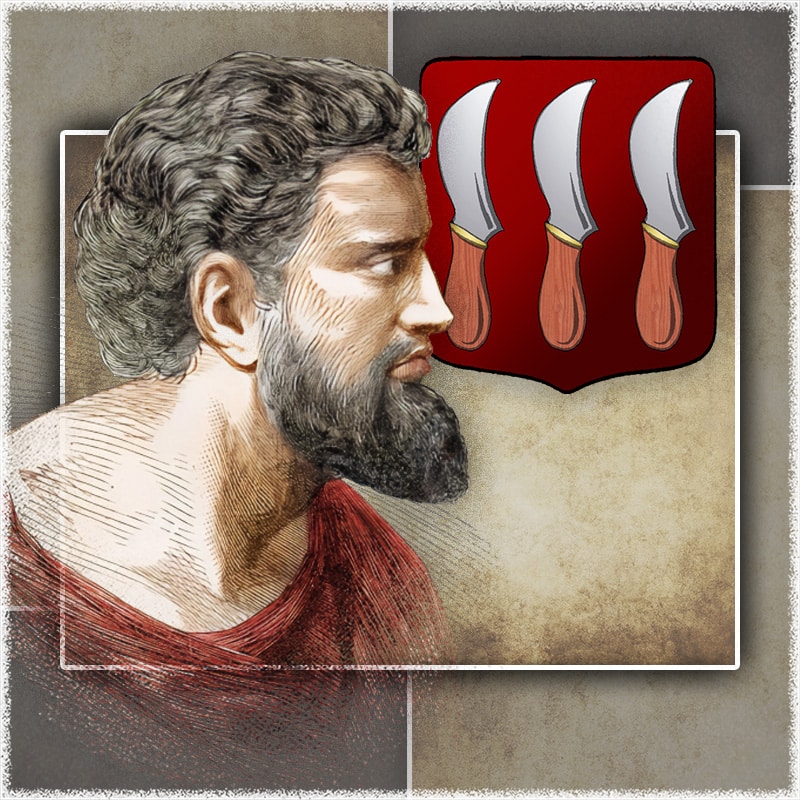
Just as it is difficult to determine with accuracy where Bartholomew invested most of his ministry, it is also difficult to accurately chronicle the last days of his life. Church tradition suggests, however, he was flayed alive with a sharp knife in one of three locations—Albanopolis, Armenia, or in India. For this reason three knives, symbolizing completeness, are employed in his apostolic symbol.
The life and ministry of the Apostle Bartholomew is remembered on August 24 by the Western Church and on June 11 in the Eastern Orthodox Church.
Celebrating Our Christian Heritage!
We are a user supported non-profit organization. Your small gift is tax-deductible and will go a long way to help us meet our operating budget — and it is vital, because
America deserves to know its true heritage.
Please contribute today!
Click to donate
America deserves to know its true heritage.
Please contribute today!
Related Articles


Article Notes and Sources
[1]Lockyer, Apostles of the Bible, 56-57.